


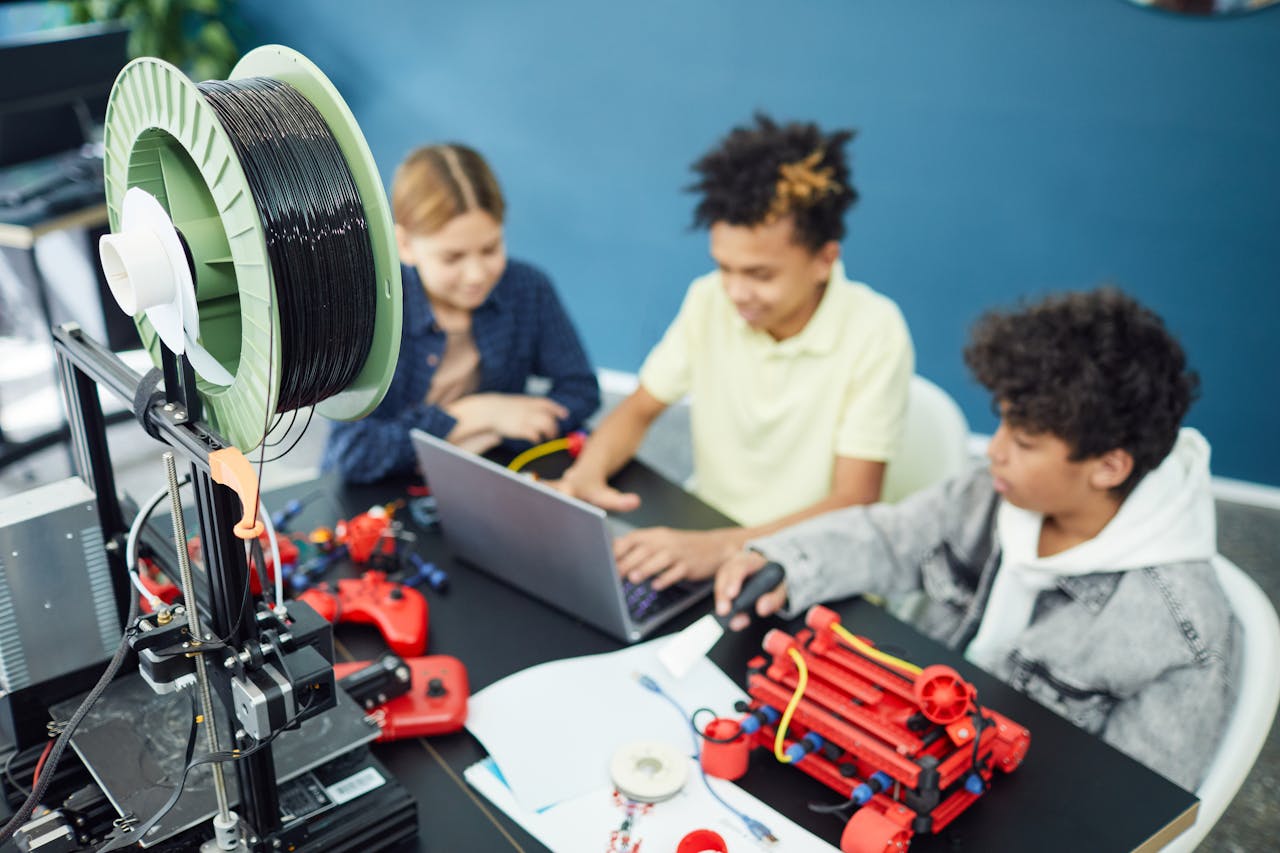
The future isn’t just coming; it’s being built, and its foundation is laid in the science, technology, engineering, and mathematics (STEM) classroom. Yet, many schools still struggle to find a meaningful way to teach these subjects. Enter robotics. It’s not just a niche after-school activity; it is the most effective interdisciplinary teaching tool available today, signaling a true Robotics Renaissance in education.
Beyond Coding: The Interdisciplinary Advantage
Robotics transcends simple coding lessons. Building a functional robot requires students to simultaneously apply:
- Physics and Engineering: How to design a stable chassis, calculate gear ratios, and manage weight distribution.
- Mathematics: Using geometry to plan movement paths and algebra to calibrate sensor data.
- Computer Science: Writing the code that brings the hardware to life.
This hands-on application makes abstract concepts tangible, turning theoretical knowledge into a working solution.
Future-Proofing Careers for the AI Economy
We are in the midst of the Fourth Industrial Revolution, defined by automation, artificial intelligence, and sophisticated cyber-physical systems. The demand for professionals who can design, manage, and maintain these systems is skyrocketing. By introducing robotics early, you aren’t just teaching a hobby; you’re equipping students with the critical skills (e.g., computational thinking, systems analysis) that are non-negotiable for future careers in every sector, from advanced manufacturing to healthcare.
Soft Skills Supercharge
In a robotics club, success is impossible without collaboration. Students learn to:
- Communicate complex technical ideas to teammates.
- Problem-Solve under pressure when a mechanism fails.
- Develop Grit and Persistence—learning that failure is simply feedback that leads to a better design iteration.
At RoboTeq, our comprehensive kits and curriculum are designed to make implementation easy for educators while maximizing these learning outcomes for students. It’s time to stop just talking about STEM and start building it.